
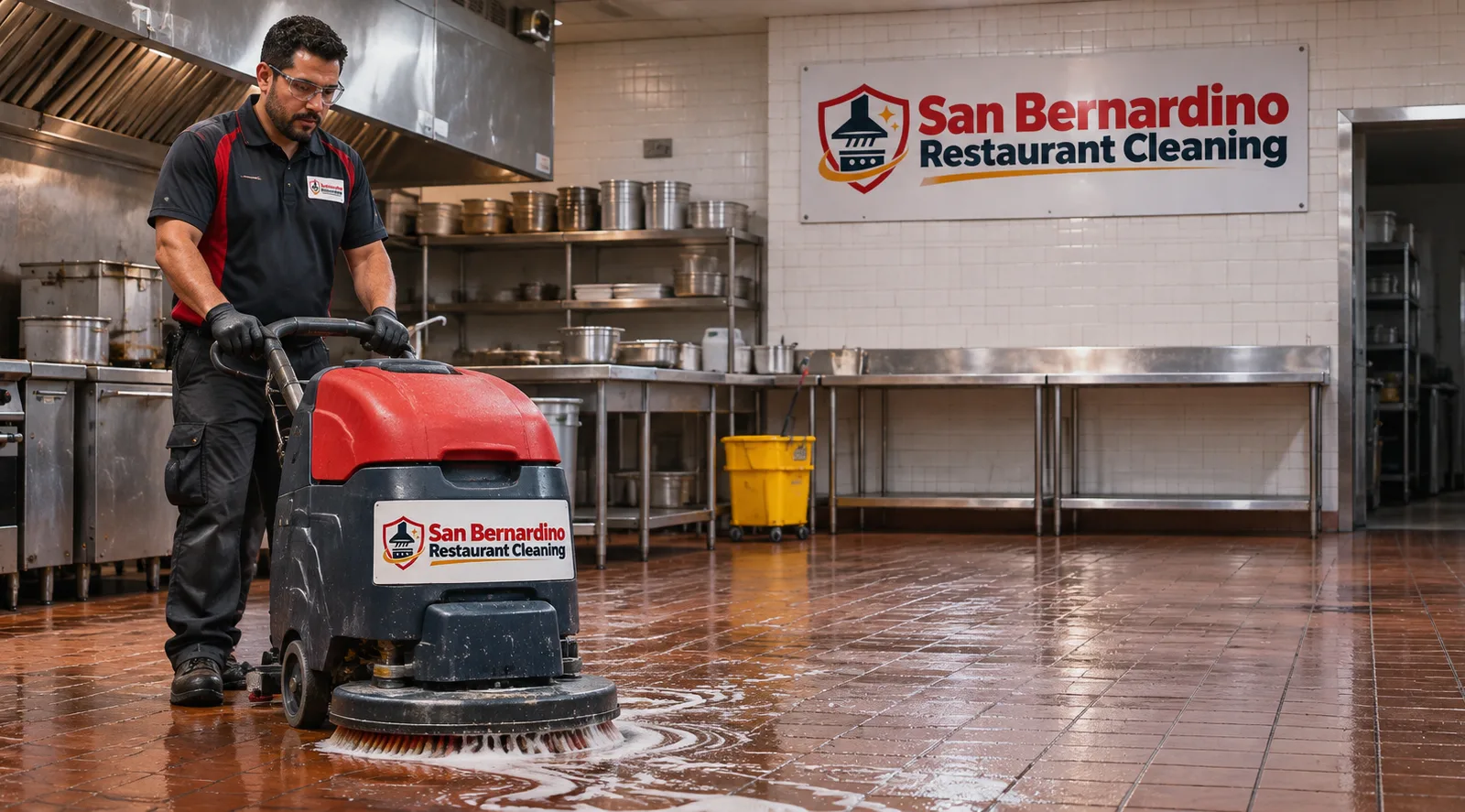
A technician using commercial floor-cleaning equipment on tile in an empty restaurant kitchen after service hours

Kitchen Floor Cleaning · San Bernardino

Commercial Kitchen Floor Cleaning

Remove built-up grease, dark grout soil and food residue with a floor-cleaning plan suited to active restaurant kitchens.

✓Tile and grout agitation ✓Commercial grease removal ✓Controlled soil recovery ✓Scope planned around operations

Operational floor care

Professional Floor Care for Working Kitchens

Commercial Kitchen Floor Cleaning addresses the greasy film, compacted soil and residue that routine mopping can leave behind. San Bernardino Restaurant Cleaning uses commercial degreasers, agitation and controlled recovery methods selected for the floor material and its condition. The goal is a cleaner walking surface without sending dirty solution into adjacent dining, storage or preparation areas.

We are a professional restaurant company in San Bernardino, CA that plans the work around the realities of food-service operations, including equipment placement, floor drains, service windows and reopening times. Our address at 207 S I St, Suite 4 places our team near Downtown San Bernardino and the I-215 corridor, which supports practical scheduling for restaurants and other commercial kitchens across the city.

A useful assessment starts with the surface itself. Quarry tile, ceramic tile, concrete and resilient commercial flooring do not all tolerate the same chemistry or agitation. We also identify cracked grout, loose tiles, failing transitions and damaged coatings before cleaning begins. Cleaning can expose those defects more clearly, but it does not repair them.
Tile and grout detail

Restaurant Tile Cleaning and Grout Soil Removal

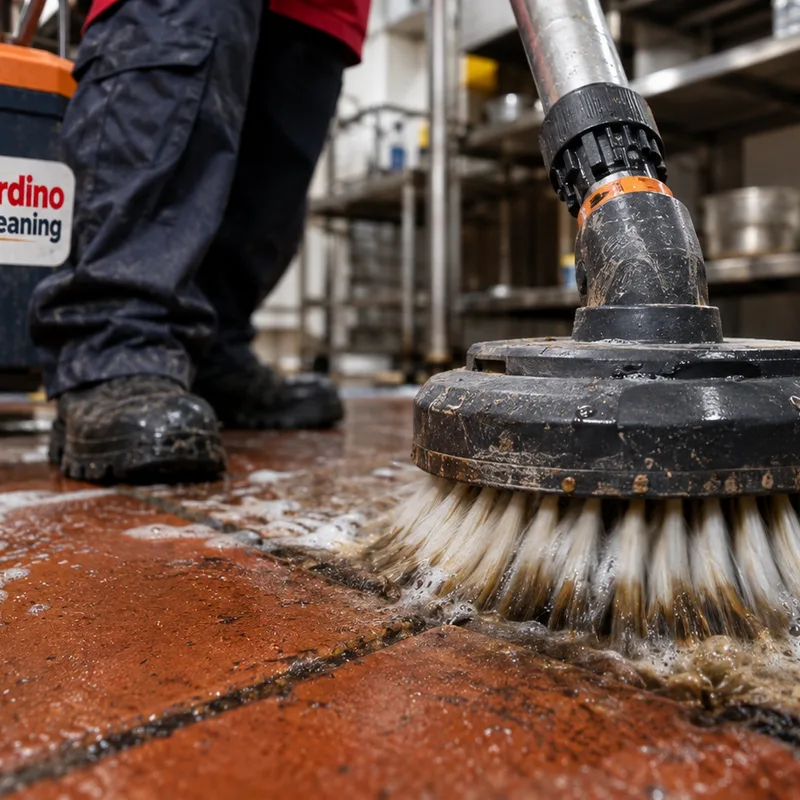
Close view of a rotary brush agitating grease-darkened grout joints between commercial quarry tiles

Kitchen tile often looks dull because grease binds fine soil to the surface. Grout joints usually darken faster because they sit lower than the tile face and collect mop water, food particles and residue. Repeatedly spreading the same solution can create a sticky film that attracts more soil after the floor dries.

Restaurant tile cleaning begins with dry debris removal and a test of the selected cleaner in a limited area. A compatible alkaline degreaser is given controlled dwell time so it can loosen oily buildup. Mechanical agitation then works the tile texture and grout joints. The suspended soil is recovered rather than redistributed, and the floor is rinsed as needed to limit detergent residue.

Restaurant grout cleaning improves appearance and removes embedded soil, but it cannot restore missing, cracked or chemically damaged grout. We identify those conditions before setting expectations. Areas beside fryers, cooking lines, dish stations and waste routes may require extra passes because the type and concentration of residue differ across the kitchen.

Detailed cleaning focus

What Restaurant Floor Cleaning Services Can Address

✓

Cooking-Line Grease

Restaurant floor degreasing breaks down oily film near fryers, ranges and preparation equipment using chemistry compatible with the floor.

✓

Soiled Grout Joints

Targeted agitation reaches recessed joints where mop solution and food soil tend to collect.

✓

Textured Tile

Brushes work into the low points of quarry and slip-resistant tile that flat mops may pass over.

✓

Dish-Area Residue

Cleaning can address food soil, detergent film and tracked residue around dish stations while accounting for nearby drains.

✓

Edges and Equipment Lines

Detail work focuses on wall edges, kick plates and accessible equipment perimeters that large machines cannot reach.

✓

Dining and Service Floors

When included in the scope, compatible methods can be used on front-of-house tile and service-counter floors.

Compatible methods and access

Kitchen Floor Degreasing Planned Around Your Operation

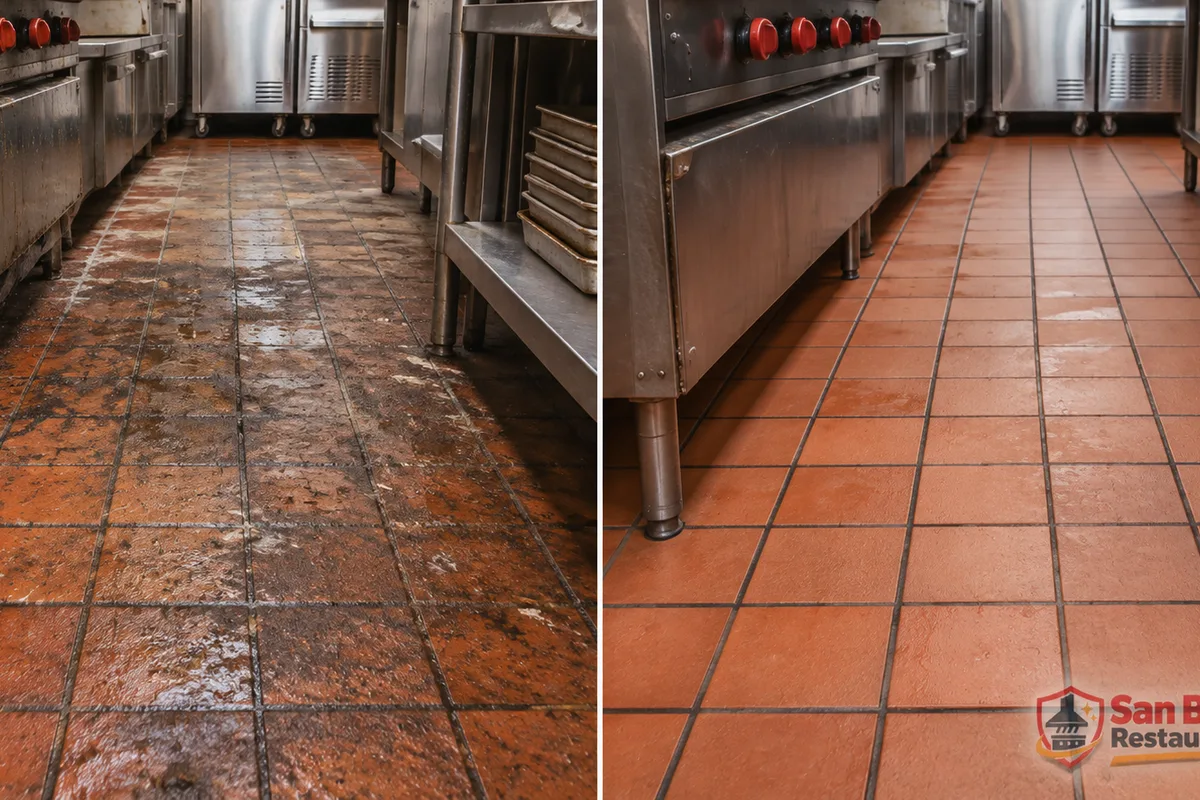
Side-by-side view of a commercial kitchen quarry-tile floor before degreasing and after soil recovery

The right degreaser is determined by the contaminant and substrate, not by strength alone. Highly alkaline products can be useful on heavy fats and oils, but concentration, dwell time and rinse control matter. An incompatible chemical can discolor flooring, damage some coatings or leave a slippery residue. We test uncertain surfaces and follow product directions rather than relying on one mixture for every floor.

Access affects the result. Freestanding equipment may be moved only when it can be handled safely and the scope allows it. Fixed cooking lines, connected appliances and crowded storage areas require a plan for cleaning accessible edges without disturbing utility connections. Staff should remove loose goods, floor mats and portable obstacles before the scheduled service unless other arrangements are made.

Hot, dry Inland Empire conditions can shorten drying time near open exterior doors, but kitchen humidity and limited airflow may keep other areas damp. We account for ventilation, drainage and the restaurant's reopening schedule instead of promising one universal drying time.

From inspection to drying

Our Commercial Kitchen Floor Cleaning Process

  1. 01

    Inspect the Floor and Soil

    We identify the flooring, buildup, grout condition, drainage, access limits and areas needing concentrated treatment.

  2. 02

    Define the Work Zone

    The cleaning area is cleared where practical, loose debris is removed and nearby surfaces or sensitive transitions are protected.

  3. 03

    Apply Compatible Degreaser

    The chosen product is diluted and applied according to its label, with enough dwell time to loosen grease without allowing the solution to dry on the floor.

  4. 04

    Agitate Tile and Grout

    Commercial equipment and detail brushes work the tile texture, grout joints, edges and accessible equipment perimeters.

  5. 05

    Recover and Rinse

    Dirty solution is collected, and additional rinsing is performed when needed to reduce loosened soil and cleaner residue.

  6. 06

    Review and Dry

    We inspect the cleaned area, note damage that cleaning cannot correct and allow practical drying time before normal foot traffic resumes.

Local operating conditions

Restaurant Floor Cleaning in San Bernardino

Commercial kitchens near Downtown San Bernardino and the Civic Center may have tight service access, limited staging space or narrow windows between closing and morning preparation. Properties near Hospitality Lane often operate around steady guest traffic and scheduled meal periods, so work-zone control and reopening time deserve early discussion. Along the I-215 corridor, loading access can vary by property, which affects equipment movement and setup.

We use these operating details to build a realistic scope rather than treating the city name as a scheduling assumption. A site visit can establish the square footage, floor material, heaviest grease zones, available water, drainage and access. It also clarifies whether the request is a one-time restorative cleaning or recurring commercial floor cleaning in San Bernardino.

Recurring frequency depends on cooking volume, menu, floor texture and daily maintenance. A high-grease cooking line may need professional degreasing more often than a lightly used preparation room. Daily sweeping, prompt spill pickup, clean mop solution and correctly diluted chemicals help preserve the result between professional visits.

Planning your budget

How Much Does Commercial Kitchen Floor Cleaning Cost in San Bernardino?

Commercial kitchen floor cleaning in San Bernardino typically costs about $0.30 to $0.90 per square foot, while small or heavily soiled jobs may carry minimum service charges of roughly $250 to $500. Intensive grout detailing, repeated degreasing or difficult equipment access can raise the total.

Final pricing depends on floor area, material, grease load, grout condition, obstacles, drainage and after-hours scheduling. A one-time restorative clean usually requires more labor than recurring maintenance. The exact cost is confirmed after an on-site inspection and written scope.

Request a Callback

Get a written cleaning scope built around your floor material, grease level, access and operating schedule.

Call for a Free Quote

Practical answers

Commercial Kitchen Floor Cleaning Questions

Review common questions about timing, after-hours access, grout results, quarry tile, equipment movement and service frequency.

How long does restaurant floor cleaning take?+

Many restaurant floor cleaning visits take several hours, but the actual time depends on square footage, grease buildup, obstacles and detail work. A compact kitchen with clear access may be completed within one service window, while a larger cooking line with dark grout and fixed equipment can require more time. Drying also varies with airflow, humidity and floor texture.

Can you clean the floor after the restaurant closes?+

After-hours scheduling may be available when arranged in advance and when the property can provide safe access. This is often practical for kitchens near Hospitality Lane or Downtown San Bernardino that need to protect meal service and morning preparation. The schedule should leave time for setup, soil recovery, inspection and adequate drying before staff return.

Will restaurant grout cleaning make every grout joint look new?+

Restaurant grout cleaning can remove substantial surface and embedded soil, but it cannot replace missing grout or reverse permanent staining and chemical damage. Grease-darkened joints may respond well to compatible chemistry and agitation. Cracks, failed patches and deep discoloration are documented so cleaning results are not confused with repair work.

Is professional kitchen floor degreasing safe for quarry tile?+

Professional kitchen floor degreasing can be suitable for quarry tile when the cleaner, dilution and agitation method match the surface and grout condition. The floor should be inspected for loose tile, damaged joints and unknown coatings first. A limited test area is appropriate when the material or prior treatment is uncertain.

Do appliances need to be moved before cleaning?+

Portable items and floor mats should usually be removed, while fixed or utility-connected appliances normally remain in place unless qualified arrangements are made. Cleaning can address accessible edges and equipment perimeters. Moving gas, electrical or plumbing-connected equipment solely for floor access is not assumed as part of routine service.

How often should a commercial kitchen floor be professionally cleaned?+

The right frequency is based on cooking volume, grease production, floor texture and the effectiveness of daily maintenance. Frying operations and textured tile often need more frequent restaurant floor degreasing than low-volume preparation areas. An initial cleaning in San Bernardino provides a practical baseline for setting a recurring schedule.

Can the kitchen remain in operation during floor cleaning?+

The active work zone should be closed to food preparation and foot traffic during cleaning. Degreaser, powered equipment, hoses and wet flooring create conditions that do not mix with normal kitchen activity. Work can often be divided into zones, but each zone needs safe isolation plus enough time for recovery, rinsing and drying.

Plan a Cleaner, Safer Kitchen Floor

Tell San Bernardino Restaurant Cleaning about the floor material, problem areas and preferred service window. We will outline the appropriate cleaning approach and confirm the scope before work begins.